Inside the 747
From 1970s upper-deck lounges to the 747-8's 787-derived cabin, and the seat maps airlines actually flew.
The 747 has had two quite different cabins in its life, separated by about forty years and a complete change in what airlines wanted from the space.
The lounge era
The earliest 747-100s carried a lounge behind the flight deck rather than a cabin, reached by a spiral staircase. Airlines competed over what to put in it — American fitted a piano bar, others fitted swivel chairs and standing bars.
The 747-200 options list gives a sense of how open the question was: a 15-place lounge, or eight first class seats plus an 11-place lounge, or 16 first class sleeper seats, or 32–45 economy seats. The same physical space, sold four different ways.
Two things ended it. The oil shocks of the 1970s made unsold floor area indefensible, and the 747-300 arrived in 1983 with a stretched upper deck and a straight staircase in place of the spiral — both changes made specifically to fit more seats in.
There is film of the classic cabin schemes, including the lounges, in the blog.
The 747-8 cabin
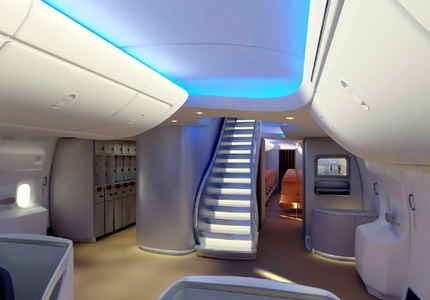
The last generation borrowed heavily from the 787: curved overhead bins, a sculpted ceiling, windows 16 percent larger than the 747-400’s, and solid-state LED lighting that can be set from sunrise to sunset across a flight.
The most visible change was a sweeping curved staircase to the upper deck, replacing the straight, narrow stair of the -300 and -400.
- The 747-8 interior in detail
- The upper deck lounges — piano bars and swivel chairs
- Three staircases — spiral, straight, then sweeping
- First class on the 747 — sleeper seats to lie-flat beds
- Galleys and crew rest — the parts nobody sees
Seat maps
Actual airline layouts — British Airways, Lufthansa, Singapore Airlines and United — are collected under seating layouts.
Related

In this section
When the hump was a bar
Piano bars, swivel chairs and spiral staircases — what airlines put in the 747's upper deck before seat counts took it back.
Three staircases
Spiral, straight, then sweeping — the 747's stair to the upper deck changed three times, and each change was about floor area.
First class on the 747
Sleeper seats, upper-deck cabins and lie-flat beds — how the 747 carried the front of the aircraft for fifty years.
Galleys and crew rest
Feeding 400 people and resting the crew that does it — the parts of a 747 cabin passengers never think about.

The 747-8 interior
The Boeing 747-8 cabin — 787-derived architecture, a curved staircase, larger windows, LED mood lighting and the VIP concepts.

The forward cabin
Boeing's rendering of the 747-8 forward cabin zone, showing the curved ceiling architecture carried over from the 787.
The door 2 entryway
The 747-8 cabin entrance at door two, where the sculpted ceiling and the staircase to the upper deck set the first impression.

The main deck cabin
A three-class main deck concept for the 747-8 Intercontinental, which seats 467 passengers in its typical layout.

The VIP concept
Boeing Business Jet's VIP concept for the 747-8 — a private lounge interior in an airframe designed for 467 passengers.

The upper deck
The 747-8 upper deck, with the curved ceiling and indirect lighting the programme took from the 787 Dreamliner.

Seating and stowage
The 747-8 cabin seating configuration and its 787-derived overhead bins, which changed how the ceiling reads.