How the 747 changed airports
Terminals, jetways, baggage halls and runway pavement all had to change for an aircraft carrying two to three times what came before.
In January 1970 a single aircraft began delivering more than 350 passengers at once to terminals designed around the 150-seat Boeing 707. Almost everything on the ground had to change, and quickly.
The surge problem
The difficulty was never the total number of passengers. It was that they arrived all at the same time.
A terminal sized for a steady trickle of narrow-body arrivals suddenly had to absorb two to three times as many people in a single pulse — through immigration, into a baggage hall, and out through customs. Queues that had been manageable became unmanageable overnight.
Airports responded with bigger arrivals halls, more immigration positions, wider circulation, and baggage systems built for far higher peak throughput. The wide-body terminal as a building type dates from this period.
Two doors, two jetways
A 747 cannot be emptied through one door in an acceptable time. Gates were rebuilt with two air bridges serving separate doors, and on some stands three — including one reaching the upper deck.
Even the geometry changed. Stands had to be spaced for a 195 ft 8 in wingspan — and later 211 ft 5 in once the 747-400 added wingtip extensions and winglets, which was enough to make some existing gates unusable.
The pavement
An aircraft weighing up to 987,000 lb cannot simply be parked anywhere. Runways, taxiways and stands are rated for load, and exceeding that rating destroys them.
This is why the 747 has eighteen wheels across five gear legs: spreading nearly 450 tonnes over enough contact patches to stay inside pavement ratings that airports could realistically build to. It is one of the least visible and most important decisions in the design.
Ground equipment had to grow too — high loaders able to reach main-deck height, larger tugs, and, for freighters, the handling gear that nose loading demands.
Hangars
Maintenance bases needed doors and roofs to match a 63 ft 6 in tail, and floor area for a wingspan over 200 ft. A D check needs the whole aircraft inside for weeks.
The lesson the A380 learned the hard way
By the 2000s the world’s major airports had spent thirty years adapting to the 747, and that infrastructure had become the baseline.
Boeing designed the 747-8 deliberately to fit inside it: same height as a 747-400, fitting existing 747 gates, so no airport needed to change anything to accept it.
The A380 went the other way and required airports to rebuild stands, widen taxiways and install upper-deck boarding — real capital spending, at a limited number of hubs, before a single passenger could be carried. That constrained where it could fly, and contributed to a production run of 254 against the 747’s 1,574.
An aircraft is only as useful as the places it can go.
Related
More in Features
Features
Longer pieces on the Boeing 747 — the factory built to make it, how it compares to the A380, what became of the retired fleet, and what it is like to fly.
The building that had to be built first
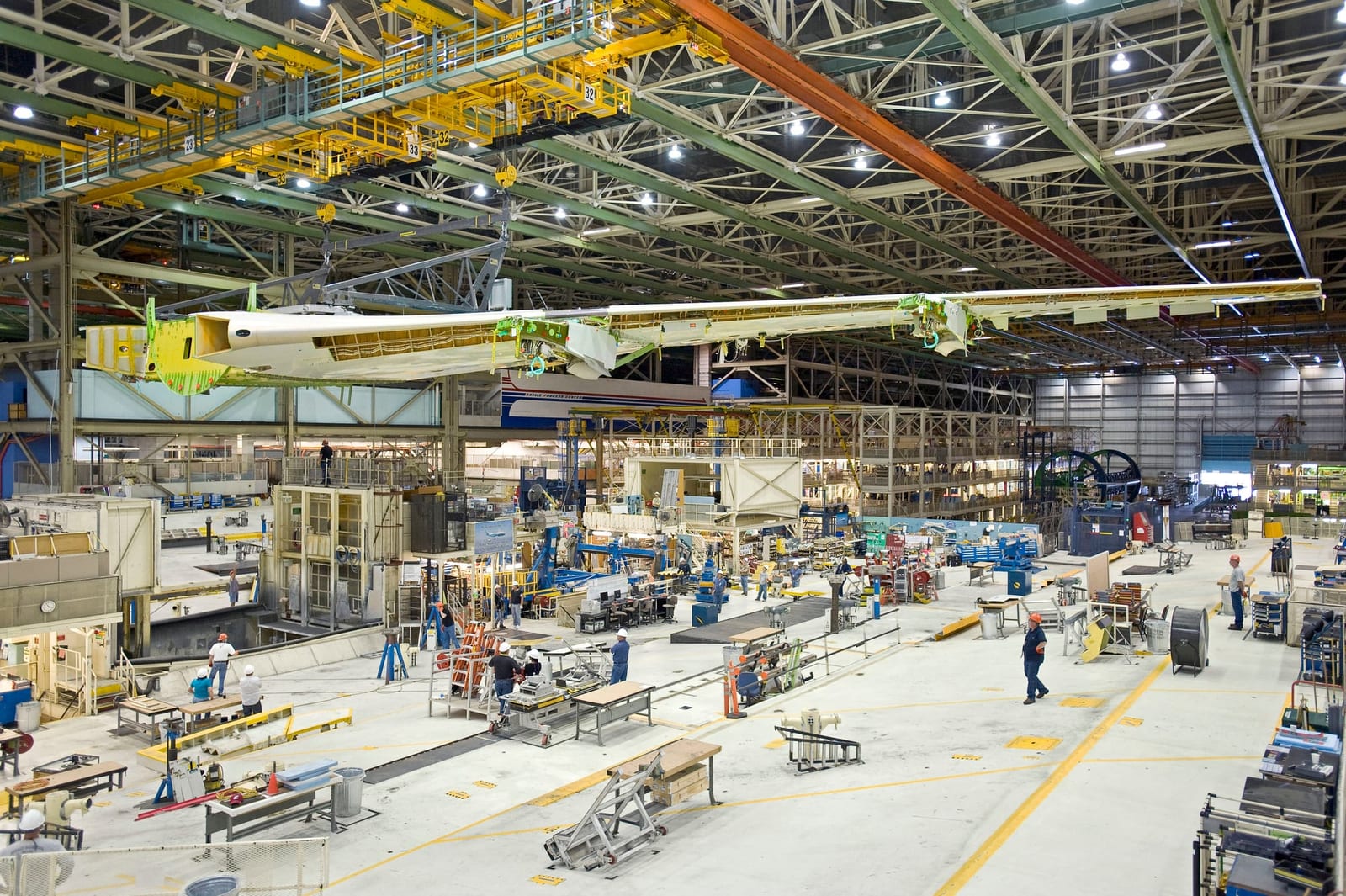
Boeing had no building big enough for the 747, so it built the largest building in the world by volume — and assembled the aeroplane while it was going up.
747 versus A380
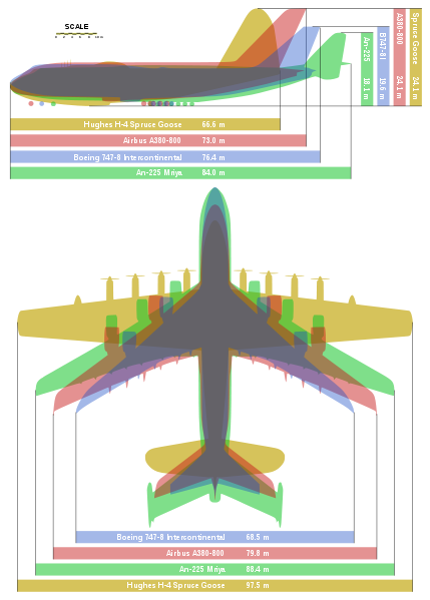
The two largest airliners ever built, compared — size, capacity, economics, and why both are now out of production.

Where the 747s went
Most retired 747s were scrapped. Others became freighters, museum pieces, restaurants, a hotel — and one launched satellites into orbit.
Flying the 747
What the 747 is like to fly — the type rating, the view from 30 feet up, the handling, and why pilots talk about it the way they do.

How 747 freight actually works
The nose door, motorised floor rollers, 96 by 125 inch pallets and 30 main-deck positions — how a 747 freighter is loaded and why it beat everything else.
