Boeing VC25 Air Force One
The Boeing VC-25A is the presidential 747. An interim 747-8, the VC-25B Bridge, entered service in 2026 ahead of Boeing's delayed VC-25B.

Flickr photos tagged with Air Force One Boeing 747
The mission of the VC-25A aircraft – Air Force One – is to provide air transport for the president of the United States. The presidential air transport fleet consists of two specially configured Boeing 747-200B’s – tail numbers 28000 and 29000 – with the Air Force designation VC-25A. When the president is aboard either aircraft, or any Air Force aircraft, the radio call sign is “Air Force One”.
Principal differences between the VC-25A and the standard Boeing 747, other than the number of passengers carried, are the electronic and communications equipment aboard Air Force One, its interior configuration and furnishings, self-contained baggage loader, front and aft air-stairs, and the capability for inflight refueling. The VC-25A is capable of flying half way around the world without refueling and can accommodate more than 70 passengers.
Accommodations for the president include an executive suite consisting of a stateroom (with dressing room, lavatory and shower) and the president’s office. A conference/dining room is also available for the president, his family and staff. Other separate accommodations are provided for guests, senior staff, Secret Service and security personnel, and the news media. Two galleys provide up to 100 meals at one sitting. Six passenger lavatories, including disabled access facilities, are provided as well as a rest area and mini-galley for the aircrew. The VC-25A also has a compartment outfitted with medical equipment and supplies for minor medical emergencies.
The first VC-25A – tail number 28000 – flew as “Air Force One” on Sept. 6, 1990, when it transported President George Bush to Kansas, Florida and back to Washington, D.C. A second VC-25A, tail number 29000 transported President Bill Clinton and former Presidents Carter and Bush to Israel for the funeral of Prime Minister Yitzhak Rabin. The VC-25A will usher presidential travel into the 21st century, upholding the proud tradition and distinction of being known as “Air Force One”.
VC-25 aircraft are extensively modified B-747-200s with the basic airframe technology of the 1960s. The aircraft incorporates state-of-the-art avionics and communications equipment with Stage III compliant engines. Boeing is currently delivering B-747s throughout the world, so the logistics support base appears secure for the foreseeable future. With the continuing march of technology and the prestige attached to the U.S. Presidential airlift fleet, Air Force plans recommend a system review date of 2010. At this point, the aircraft will have been in service 20 years, and commercial operators will have retired their B-747-200s counterparts from front-line service.
These aircraft are flown by the presidential aircrew, maintained by the Presidential Maintenance Branch, and are assigned to Air Mobility Command’s 89th Airlift Wing, Andrews Air Force Base, MD.
Air Force One is managed by Tinker Air Force Base personnel from the Contractor Logistics Support Management Directorate. Tinker has managed Air Force One since the airplanes were originally delivered back in 1990. The directorate manages Air Force One’s day-to-day issues like supply and logistics support, while at the same time ensuring the aircraft are maintained to Federal Aviation Administration regulatory standards. This support also includes engineering and technical support, production management, modification management, budget management and contracting. Programmed Depot Maintenance [PDM] is also managed by this directorate, but the work is contracted out to Boeing’s Wichita, Kan., facility. PDM is performed on one of the two Air Force One aircraft every year. To comply with a recent FAA mandate, one aircraft was updated with a new Fuel Quantity Indicating System.
Heavy maintenance, completed on that aircraft in December 2000, included installation of the Global Positioning System and Flight Management Computer System. These systems were added as part of increasing FAA mandates to help make the aircraft more efficient. The second Air Force One aircraft was compliant with the FAA mandate when it rolled out of PDM later in 2001. In the wake of the TWA Flight 800 explosion, the FAA and the National Transportation Safety Board issued an Airworthiness Directive requiring anyone who maintains a 747 install a new FQIS with safety provisions that resulted from the TWA 800 investigation.
In the early 1990s Air Force One was secretly outfitted with a directed infrared countermeasures (DIRCM) system to protect it from a missile attack. According to some reports, the plane can also eject flares to throw heat-seeking missiles off course.
Air Force One
Inside Air Force One
Replacement
The two VC-25As entered service in 1990 and are now well beyond their originally planned lives. Their replacements, designated VC-25B, are based on the 747-8 — two airframes originally built for a customer that never took delivery, and among the last 747s produced. The conversion has run substantially over schedule and budget; delivery is now expected around mid-2028.
To bridge that delay, the United States accepted a Boeing 747-8 given by Qatar in 2025. Converted by L3Harris and designated the VC-25B Bridge, it entered service as an interim Air Force One on 1 July 2026.
The three are easily confused. The VC-25A is the 747-200B-based pair flying since 1990; the VC-25B is Boeing’s purpose-built 747-8 pair, still to be delivered; and the VC-25B Bridge is the converted Qatari aircraft now in service.
| Manufacturer | Boeing |
|---|---|
| Variant | Boeing VC-25A |
| Introduced | 1990 |
| Status | In service; interim VC-25B Bridge added 2026, VC-25B due around 2028 |

Video
Frequently asked questions
- What aircraft is Air Force One?
- Air Force One is a call sign, not an aircraft type. It applies to any US Air Force aircraft carrying the President, but is most associated with the two Boeing VC-25A aircraft derived from the 747-200B.
More in Special Boeing 747s

Special Boeing 747s
The 747s built for jobs no airliner does — Air Force One, the Dreamlifter, the Shuttle Carrier, a flying observatory, a firefighting tanker and an airborne laser.

The 747 ASB
Boeing's 1986 answer to the Airbus A340 and MD-11 — a shortened 747 with 747-400 technology. It was never built.
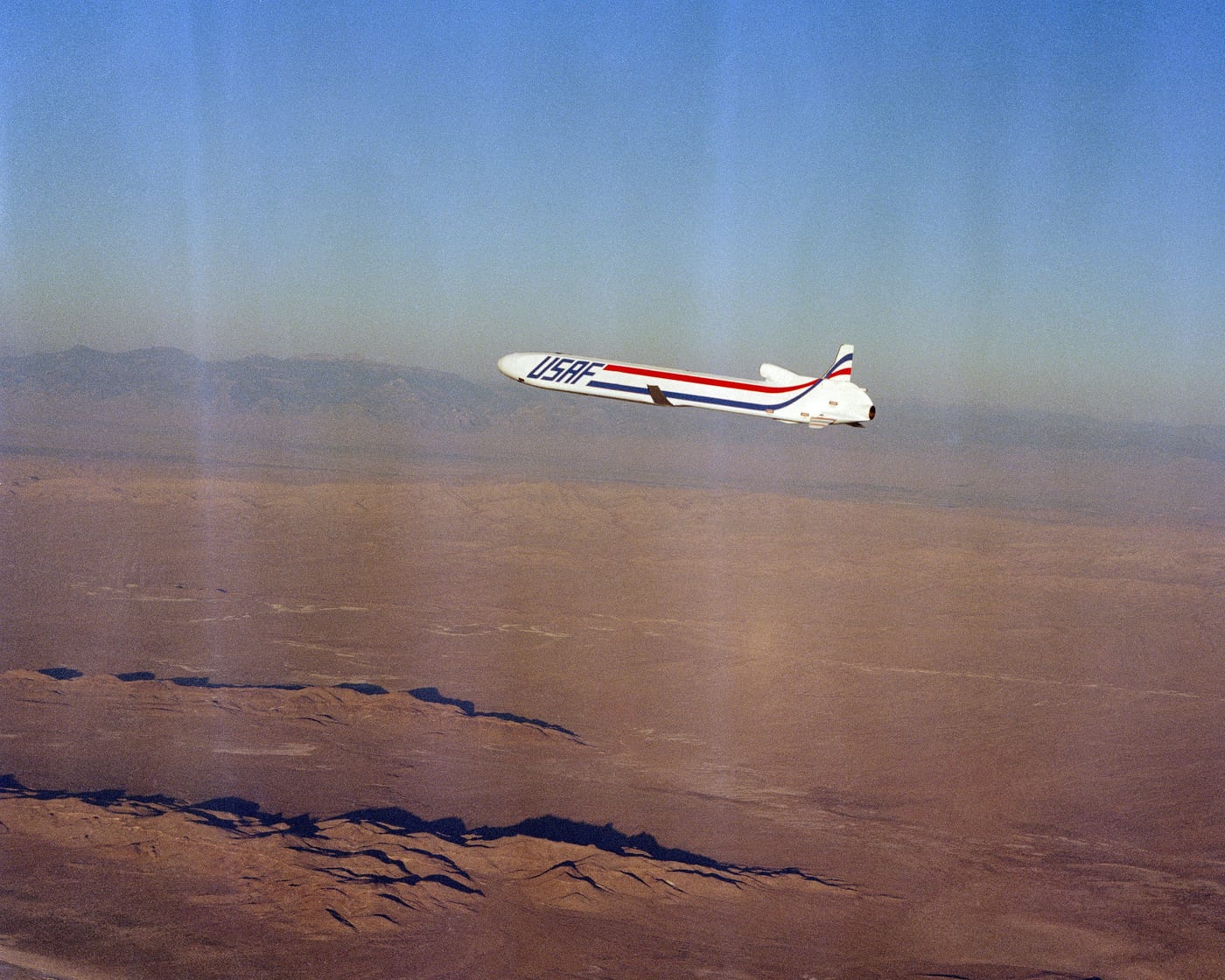
The 747 CMCA
A proposed USAF Boeing 747 armed with up to 72 cruise missiles on rotary launchers, studied during B-1 development. It was never built.

The Boeing Dreamlifter
Four 747-400s rebuilt with a swollen fuselage and a swing tail to carry Boeing 787 wings and fuselage barrels between factories.

The 747 as a flying testbed
General Electric, Rolls-Royce and Pratt & Whitney all fly engines on 747s — because a four-engined aircraft can carry a strange engine safely.

SOFIA — the flying observatory
A former airline 747SP carrying a 2.5 m infrared telescope, flying above the water vapour that blocks infrared light from the ground. Retired 2022.