Joe Sutter, father of the 747
Joe Sutter (1921-2016) led the 747's design team, and made the decision that gave the aircraft a wide single deck rather than two narrow ones.
Joe Sutter (1921–2016) was chief engineer for the Boeing 747, and is universally called its father.
The career
Born in Seattle on 21 March 1921, within sight of the industry he would spend his life in. He took a degree in aeronautical engineering from the University of Washington in 1943, and joined Boeing in 1945.
He never worked anywhere else. He retired in 1986 as executive vice president for commercial aeroplane engineering and product development, having been vice president and general manager of the 747 programme. Forty years, one company, one aircraft that defined it.
He died in 2016, aged 95.
The Incredibles
Sutter led a team of about 4,500 engineers, who took the 747 from launch to first flight in roughly 29 months — a schedule that would be considered impossible today for an aircraft of that size and novelty.
They became known inside Boeing as “the Incredibles”, and the name stuck because it was not really an exaggeration. They were designing the first wide-body airliner, in a factory being built around them, for a company betting its existence on the outcome.
The decision that mattered most
The 747 could easily have been a double-decker. Two narrow decks was the obvious way to get the passenger numbers Pan Am wanted from a fuselage of manageable width, and it was seriously considered.
Sutter’s team rejected it, and the reasoning was mostly about evacuation and freight.
Evacuating an upper deck in the required time is very hard — the escape slides are long and the geometry unforgiving. And a double-decker’s cross-section is poorly suited to standard cargo containers, which mattered enormously given that the 747 was designed to become a freighter once supersonic airliners took over passenger flying.
So they went wide instead of tall: a single main deck broad enough for two aisles and, below it, a hold that could take containers side by side. That created the wide-body category, which every long-haul airliner since has belonged to.
The upper deck exists only because the flight deck had to be lifted clear of the nose cargo door. It was a consequence, not a goal — which is why it started life as a lounge rather than a cabin.
The other decision
Four engines rather than two was not really a choice at the time: engines of the necessary thrust did not exist, and twins were barred from long overwater routes anyway. It took another twenty years of engine development and ETOPS relaxation before Sutter’s aircraft could be replaced by a twin — which, in the end, it was, by Boeing’s own 777.
What he got right
The proof is in how little the aircraft’s basic architecture changed. The 747-8 delivered in 2023 has the same fuselage cross-section, the same general layout and the same nose door as the 747-100 that first flew in 1969.
1,574 aircraft over 54 years were built on decisions made by a team working to a 29-month schedule in the mid-1960s.
Related
Frequently asked questions
- Who designed the Boeing 747?
- Joe Sutter was chief engineer for the 747 and is known as its father. He led a team of about 4,500 engineers, who became known as "the Incredibles", and the aircraft went from launch to first flight in roughly 29 months.
More in Features
Features
Longer pieces on the Boeing 747 — the factory built to make it, how it compares to the A380, what became of the retired fleet, and what it is like to fly.
The building that had to be built first
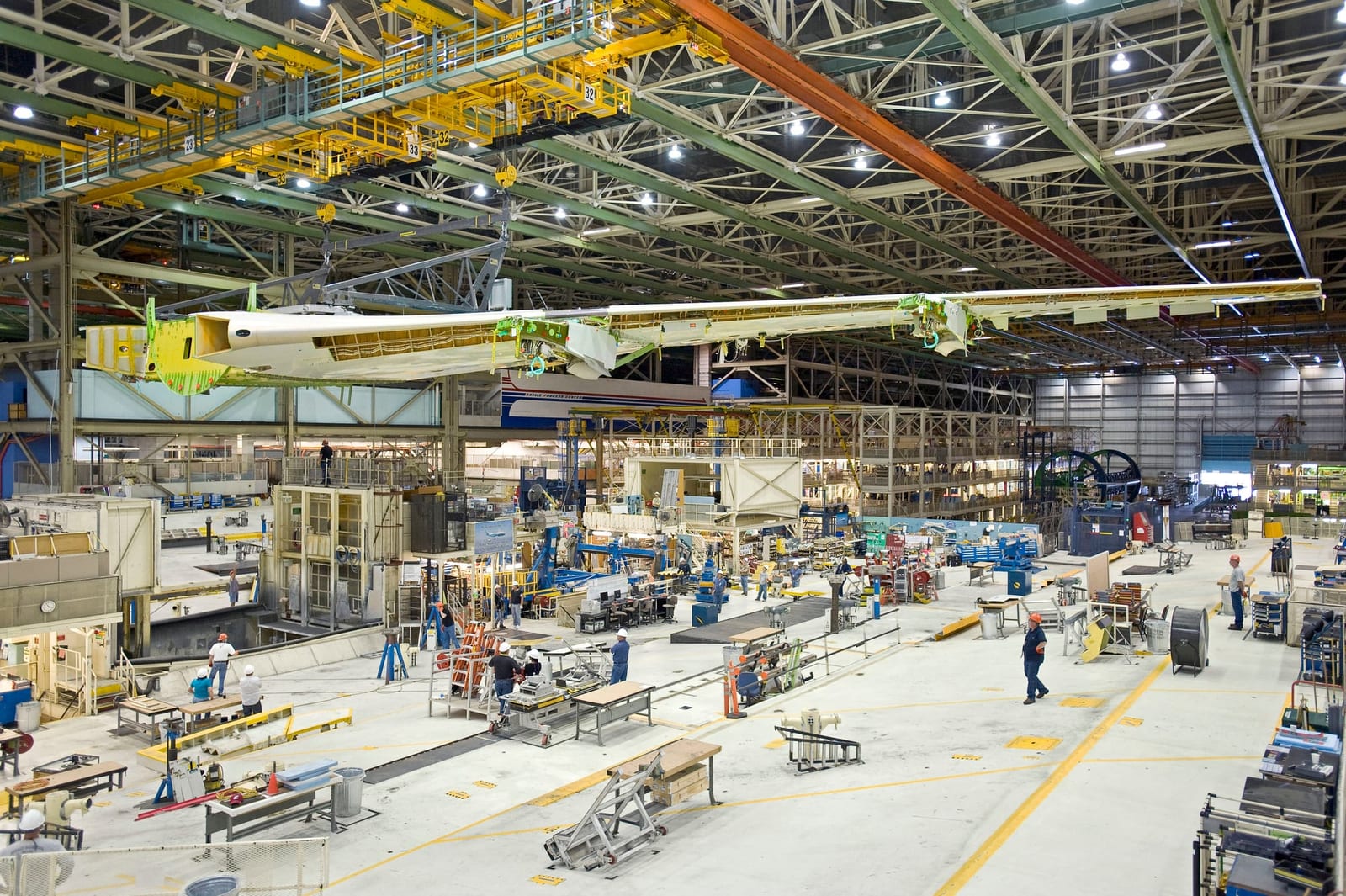
Boeing had no building big enough for the 747, so it built the largest building in the world by volume — and assembled the aeroplane while it was going up.
747 versus A380
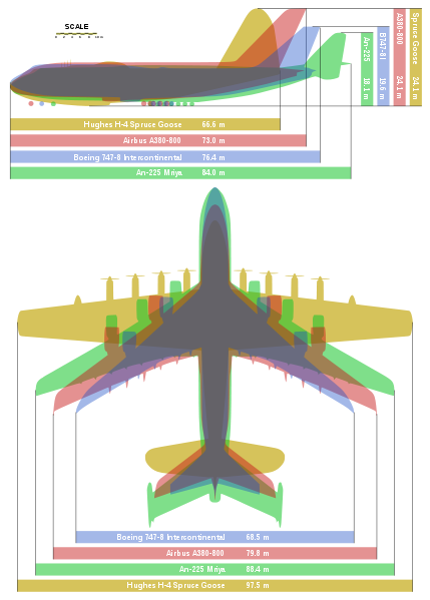
The two largest airliners ever built, compared — size, capacity, economics, and why both are now out of production.

Where the 747s went
Most retired 747s were scrapped. Others became freighters, museum pieces, restaurants, a hotel — and one launched satellites into orbit.
Flying the 747
What the 747 is like to fly — the type rating, the view from 30 feet up, the handling, and why pilots talk about it the way they do.

How 747 freight actually works
The nose door, motorised floor rollers, 96 by 125 inch pallets and 30 main-deck positions — how a 747 freighter is loaded and why it beat everything else.
