Eighteen wheels
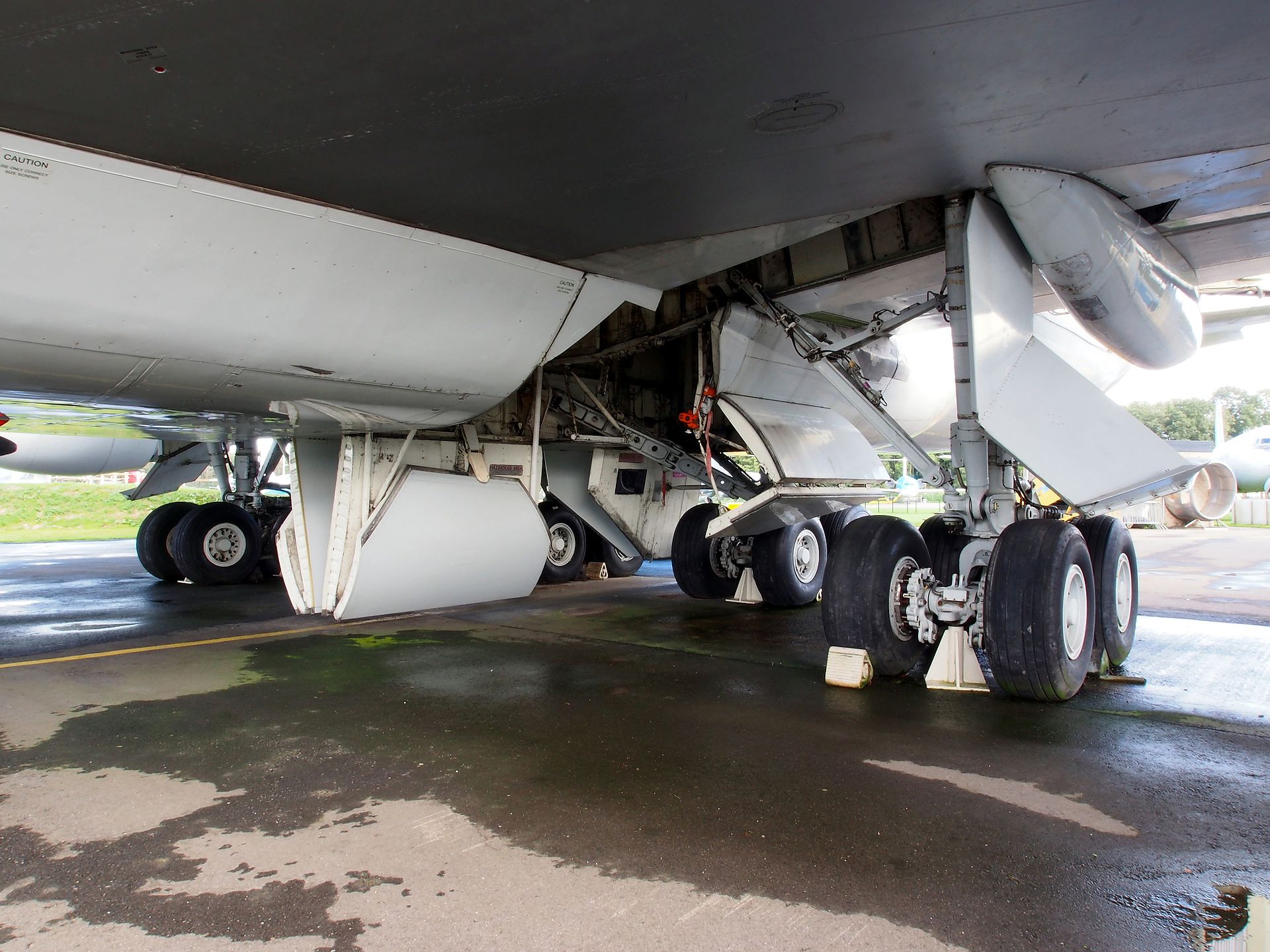
Five gear legs, 18 tyres, and a body gear steering system that counter-steers to keep a 400-tonne aircraft from scrubbing its tyres off in a turn.

A fully loaded 747-8 weighs up to 987,000 lb (447,700 kg) at takeoff. All of it rests on eighteen tyres, and the arrangement is more considered than it looks.
Five legs
| Gear | Wheels |
|---|---|
| Nose | 2 |
| Wing gear (2 legs, one under each wing root) | 8 |
| Body gear (2 legs, under the fuselage) | 8 |
| Total | 18 |
Four main legs of four wheels each, plus the nose. The wing gear retracts inward toward the fuselage; the body gear retracts forward.
Why so many wheels
Not to carry the weight — a smaller number of larger tyres could do that. It is about pavement loading.
Runways and taxiways are rated for a maximum load per unit area. An aircraft that concentrates its weight on too few contact patches will be barred from airports whose pavement cannot take it, or will require them to be rebuilt. Spreading nearly 450 tonnes across eighteen tyres and four widely separated legs keeps the 747 within the pavement ratings of airports it needs to serve.
That decision is also why the 747-8 was able to enter service without airports rebuilding anything — a pointed contrast with the A380.
There is a redundancy benefit too: the aircraft can be landed safely with some wheels or brakes unavailable.
Body gear steering
Here is the part most people never notice. A 747 turning tightly on a taxiway would, with a fixed main gear, drag its rear wheels sideways across the pavement — scrubbing rubber off the tyres, loading the gear legs sideways and chewing up the surface.
So the body gear steers, and it steers the opposite way to the nose wheel, because it sits on the other side of the turn’s centre point.
- It arms once nose wheel steering passes roughly 20 degrees.
- At full nose deflection of 70 degrees, the body gear reaches about 13 degrees on the inboard truck and 11 degrees on the outboard.
- On the 747-400 it is fully automatic, enabling and disabling around 20 knots. On the -100, -200 and -300 it had a crew-operated arm switch.
The payoff is a tighter turning circle, less tyre wear, less brake and thrust needed to get round a corner, and lower stress in the gear.
Brakes
The brakes are the reason the rejected takeoff test is the most demanding certification event the aircraft faces: they must absorb the entire kinetic energy of a near-million-pound aircraft at takeoff speed and turn it into heat, on worn brakes, with no reverse thrust and no cooling.
Tyres carry fuse plugs designed to melt and release pressure in that situation, so a tyre deflates rather than bursting.
A side effect nobody designed for
Because the wing and body gear are spread fore and aft, a 747 is stable enough to have heavy freight loaded into the rear fuselage without sitting back on its tail. That is precisely what makes the Combi possible — cargo loading through a rear side door while passengers board at the front.
Related
Video
Frequently asked questions
- How many wheels does a Boeing 747 have?
- Eighteen. Two on the nose gear and sixteen on the main gear — four legs of four wheels each, two attached to the wings and two to the fuselage.
- Does the Boeing 747's main landing gear steer?
- Yes. The two body gear units steer, in the opposite direction to the nose wheel, once nose steering passes about 20 degrees. It reduces tyre scrub and tightens the turning circle.
More in Aircraft Systems

How the 747 works
The systems that make a 747 fly — fuel, hydraulics, landing gear, electrics and pressurisation, explained one at a time.
Boeing 747 specifications compared
Every Boeing 747 variant side by side — length, wingspan, weights, capacity, range, cruise speed and engines, with sources noted.
The four hydraulic systems
The 747 has four independent hydraulic systems, one per engine, each with a backup pump — and the reasoning behind splitting them that way.

Flight controls and high-lift devices
How a 747 is flown — split ailerons, spoilers, triple-slotted flaps and Krueger leading edge devices, and what the 747-8 changed.
The electrical system
Four 90 kVA generators, one per engine, running in parallel through a tie bus — plus two APU generators for the ground.
Pressurisation and air conditioning
How a 747 keeps a breathable cabin at 35,000 ft, why the fuselage is a pressure vessel, and why cycles matter more than hours.