Boeing 747 Classic Cabin Schemes
Classic 747 cabin schemes and upper-deck lounges; the original video is unavailable.
A note on this page. The original clip used a player that no longer works. The same film has since been found on YouTube and is embedded above, along with two others on the same subject.
Classic Boeing 747 cabin schemes, from the era when the upper deck was a lounge rather than a cabin.
The hump was never meant to hold seats
The 747’s upper deck exists because of the nose cargo door. Boeing expected supersonic airliners to take over long-haul passenger flying, so the 747 was designed to convert to a freighter — which meant the flight deck had to sit above the main deck to leave the nose clear.
That left a space behind the cockpit with no assigned purpose. On the earliest aircraft it held a lounge, reached by a spiral staircase, and airlines competed over what to put in it.
American Airlines fitted a piano bar. Continental had a lounge with swivel chairs. Qantas, Pan Am and others fitted their own variations. The 747-200’s options list offered a 15-place lounge, eight first class seats plus an 11-place lounge, 16 first class sleeper seats, or 32–45 economy seats.
Why the lounges disappeared
Economics, in two stages.
First, the oil shocks of the 1970s made every square foot of a wide-body cabin something that had to earn its keep. A lounge generates no revenue.
Second, the 747-300 arrived in 1983 with a stretched upper deck — 23 ft 4 in longer — and a straight staircase instead of the spiral. Both changes existed to create room for more seats, above and below. Once the space was big enough to be a proper cabin, it became one.
By the 747-400 the upper deck was a premium cabin, and it stayed that way to the end.
Related
Video
More in Blog
Blog
News and notes about the Boeing 747 — retirements, deliveries, special liveries, engine milestones and unusual operations.
Air Force One slips again, and the cracks behind it
A Pentagon report puts the VC-25B cabin behind schedule, with hundreds of airframe repairs outstanding and delivery now expected in 2028.
Cosmic Girl's third career: launching hypersonic vehicles
The 747 that launched satellites for Virgin Orbit is now Stratolaunch's Spirit of Mojave, air-launching the Talon-A hypersonic testbed.
Lufthansa to sell two 747-8s and retire more 747-400s
The largest passenger 747 operator is thinning its fleet — but says the 747-8 stays core to long-haul into the 2030s.
How many 747s are still flying?
Around 85 passenger 747s and close to 300 in cargo, charter and government service — and why that ratio is the aircraft's whole late story.
Qatar 747-8 enters service as Air Force One
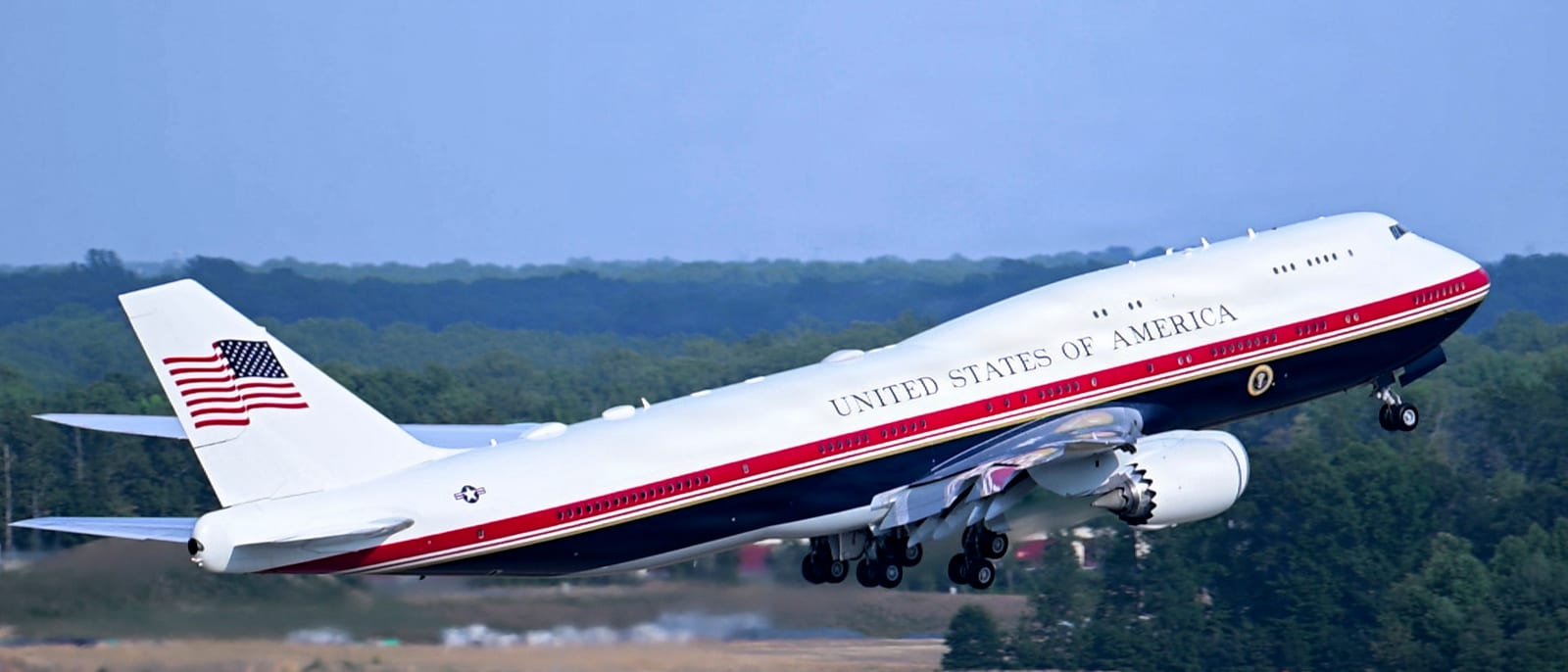
The Boeing 747-8 given to the United States by Qatar flew its first presidential mission on 1 July 2026, designated the VC-25B Bridge.