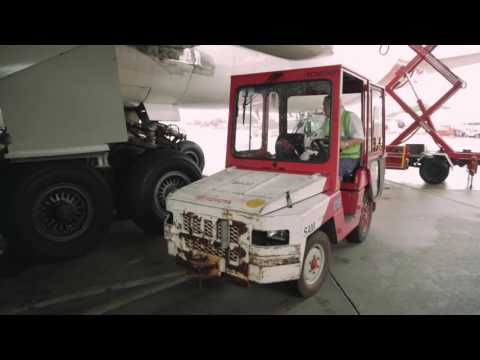
Why does a Boeing 747-400 have winglets?
Winglets reduce wingtip vortices and induced drag, lowering fuel burn on the 747-400.

In order for an aircraft to gain any lift whatsoever, there must be a difference in pressure between the top and bottom of the wing. Below the wing you have high pressure air, above the wing you have low pressure air. This is how lift is accomplished by the wing. The high pressure air is heavier than the low pressure, so the plane has no choice but to remain aloft. (which is why flying is unbelievably safe)
At the end of the wing, there is a turbulent mixture of the high and low pressure air. This mixing point, roughly at the location of the winglets, causes drag and can cause an aircraft to become inefficient. The winglets assist in eliminating some of this drag, therefore adding range and in some cases, quite a bit of exterior style to an aircraft. (my opinion)
Every aircraft is designed differently, so winglets are efficient only on certain models. Aerodynamic variation in aircraft design can be either helped or hurt by winglets. The particular model in this question, the 747-400, usually comes with them, BUT, some airlines have opted to not have them installed on their new planes (Boeing 747-400D - Domestic). Japan Airlines did this because they use the new plane for shorter high capacity hauls versus flying across the Pacific.
Update
There is a good postscript to this, and it is the exception that proves the rule.
The 747-400D, built for Japanese domestic routes, was delivered without winglets — deliberately. On a one-hour sector an aircraft spends most of its time climbing and descending rather than cruising, so the drag saving never repays the weight the winglets add, and removing them lowers the bending loads on a wing that has to survive an extraordinary number of takeoffs and landings.
Nineteen were built, and they are the only 747-400s without them.
The 747-8 then abandoned winglets altogether in favour of raked wingtips — an extension swept sharply back rather than turned upward — as part of an entirely new wing. Same objective, different solution.
Frequently asked questions
- Why does a Boeing 747-400 have winglets?
- Lift depends on a pressure difference between the upper and lower wing surfaces. At the wingtip, higher-pressure air below spills around into the lower-pressure air above, creating a vortex that produces induced drag. Winglets reduce that spill-over, cutting drag and fuel burn.
More in Blog
Blog
News and notes about the Boeing 747 — retirements, deliveries, special liveries, engine milestones and unusual operations.
Air Force One slips again, and the cracks behind it
A Pentagon report puts the VC-25B cabin behind schedule, with hundreds of airframe repairs outstanding and delivery now expected in 2028.
Cosmic Girl's third career: launching hypersonic vehicles
The 747 that launched satellites for Virgin Orbit is now Stratolaunch's Spirit of Mojave, air-launching the Talon-A hypersonic testbed.
Lufthansa to sell two 747-8s and retire more 747-400s
The largest passenger 747 operator is thinning its fleet — but says the 747-8 stays core to long-haul into the 2030s.
How many 747s are still flying?
Around 85 passenger 747s and close to 300 in cargo, charter and government service — and why that ratio is the aircraft's whole late story.
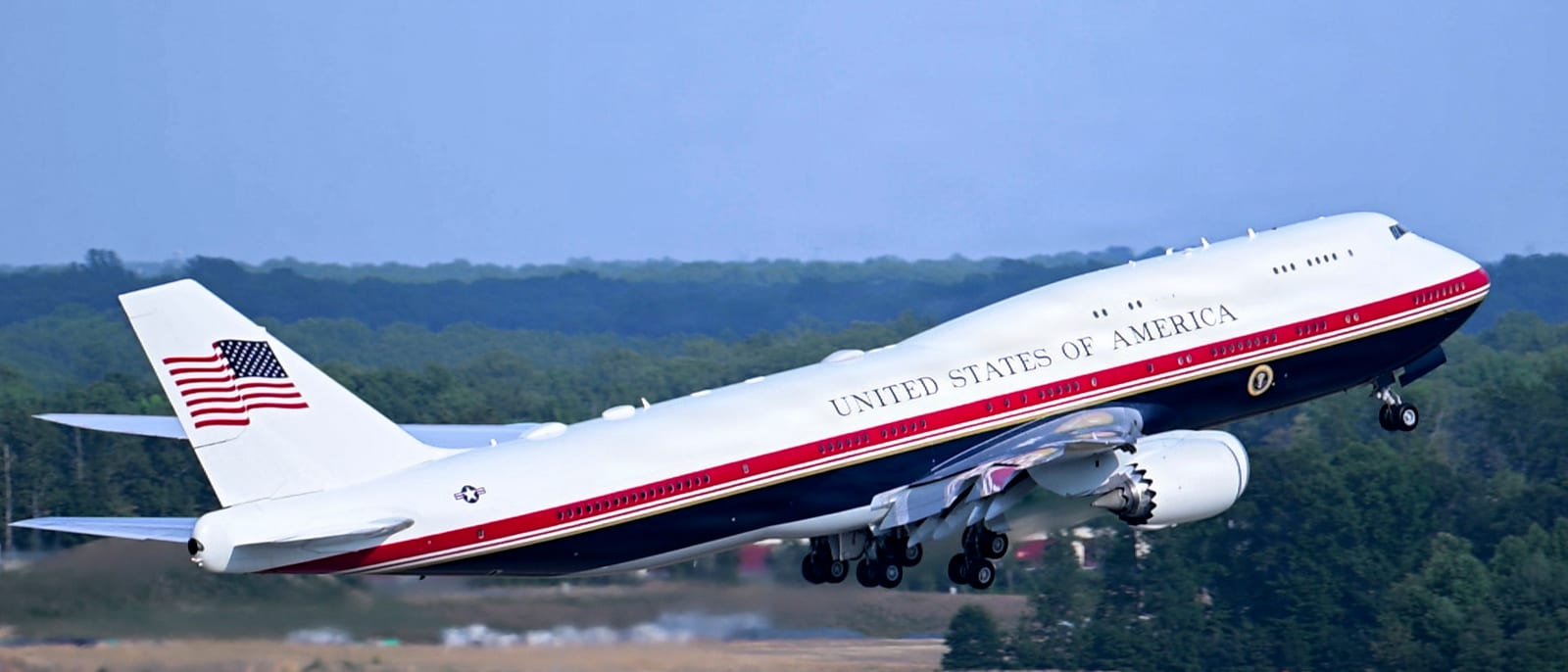
Qatar 747-8 enters service as Air Force One
The Boeing 747-8 given to the United States by Qatar flew its first presidential mission on 1 July 2026, designated the VC-25B Bridge.