The 747-8 and the environment
The 747-8 cut fuel burn and carbon emissions by about 16 percent per seat against the 747-400, with a noise footprint roughly 30 percent smaller.

Environmental performance was central to the 747-8's sales case, because by the mid-2000s noise and emissions limits were increasingly deciding where and when large aircraft could operate at all.
Emissions
The 747-8 meets or exceeds the limits then in force for hydrocarbons, carbon monoxide, smoke and oxides of nitrogen.
The larger figure is fuel burn. The new wing and the GEnx-2B engines together cut consumption by around 16 percent per seat against the 747-400 - and because carbon dioxide output is directly proportional to fuel burned, that is also roughly a 16 percent reduction in CO₂ per seat.
Noise
The 747-8's noise footprint is about 30 percent smaller than the 747-400's. The footprint is the area on the ground exposed to a given noise level, so a 30 percent reduction means noticeably fewer people underneath the departure and approach paths are affected.
Several things contribute: the chevron nacelles on the GEnx engines, the higher bypass ratio, and wing features that were chosen partly for noise - the drooping ailerons that act as extra high-lift devices when the flaps extend, the redesigned flap tracks and fairings, and the gapped Krueger flaps.
Why Heathrow mattered
Boeing made a specific claim that shows what the noise reduction was worth commercially: the 747-8 would be able to operate at London Heathrow around the clock, while most aircraft are subject to a night-time curfew on noise grounds.
For an airline, an aircraft that can use a slot-constrained airport at hours when rivals cannot is worth real money - which is why noise engineering on the 747-8 was not simply a matter of regulatory compliance.

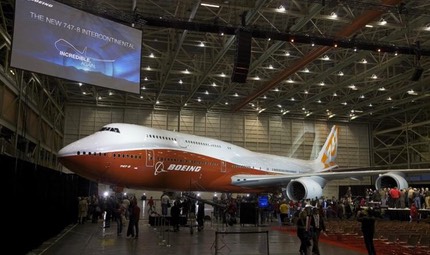
Most of the improvement comes from the wing and the GEnx-2B engines beneath it.Boeing

Frequently asked questions
- How much quieter is the 747-8 than the 747-400?
- Boeing put the 747-8's noise footprint at about 30 percent smaller than the 747-400's. It was quiet enough to meet London Heathrow's night-time noise limits, where most aircraft face a curfew.
- How much more efficient is the 747-8?
- About 16 percent less fuel per seat than the 747-400, which translates directly into roughly 16 percent lower carbon dioxide emissions per seat.
Sources
Facts on this page are checked against the primary and institutional references below.
- Boeing 747-8 - Boeing
- 747-8 Airplane Characteristics for Airport Planning - Boeing
Related topics
Listen to Boeing 747 engines
Listen to licensed Boeing 747 recordings, compare RB211 and GEnx-2B engines, filter by flight phase and download credited audio clips.
A stretched 747-400 with one new engine
The 747-8 is a re-engined, stretched 747-400 derivative with GEnx engines, a bigger APU and more electrical power.
Boeing 747-400 vs 747-8
The 747-8 is bigger, heavier and quieter than the 747-400, with a new wing, GEnx-2B engines and a stretched fuselage - but it sells a fraction as well.
Compare aircraft sizes
Compare Boeing 747 variants, the Airbus A380 and Boeing 777 on one scale. Overlay their dimensions, switch views and see lengths and wingspans.
Boeing 747: History, Variants and Legacy
A complete reference to the Boeing 747, built from 1968 to 2023 - every variant from the 747-100 to the 747-8, plus special-mission jumbos and photos.
The small gas turbine that keeps the big one flying
A small gas turbine in the 747's tail cone supplies bleed air and electricity on the ground and as a backup in flight.
More in Everything About the 747-8

The Boeing 747-8
A guide to the final 747 - the stretched fuselage, new wing, GEnx-2B engines, 787-derived flight deck and the freighter that closed the production line.

Preserved Boeing 747s You Can Visit
A source-backed directory and map of preserved Boeing 747s at museums and public exhibits worldwide, with registrations and official visitor links.

747 Timeline
A Boeing 747 chronology from the 1963 design study to the final delivery in January 2023, with rollout, first flight and delivery dates.

Fun Facts from Boeing
Boeing 747 facts and figures - six million parts, the largest building on Earth, 1,088 people on one flight, and 1,574 aircraft built over 54 years.

The 747-8 cabin experience
Larger windows, a sculpted 787-style ceiling, LED mood lighting and a quieter cabin than any previous 747.

747-8 vs 747-400
Externally similar, mechanically different - the 747-8 has a longer fuselage, a new wing, higher-bypass engines and a higher gross weight than the 747-400.